![EOScu Logo - Dark - Outlined [07182023]-01](https://blog.eoscu.com/hubfs/Eoscu_June2024/Images/EOScu%20Logo%20-%20Dark%20-%20Outlined%20%5B07182023%5D-01.svg)

In an effort to reduce patient harm, Medicare continues to penalize hospitals with the highest...
Medicare, Medicaid and the Fight Against HAIs
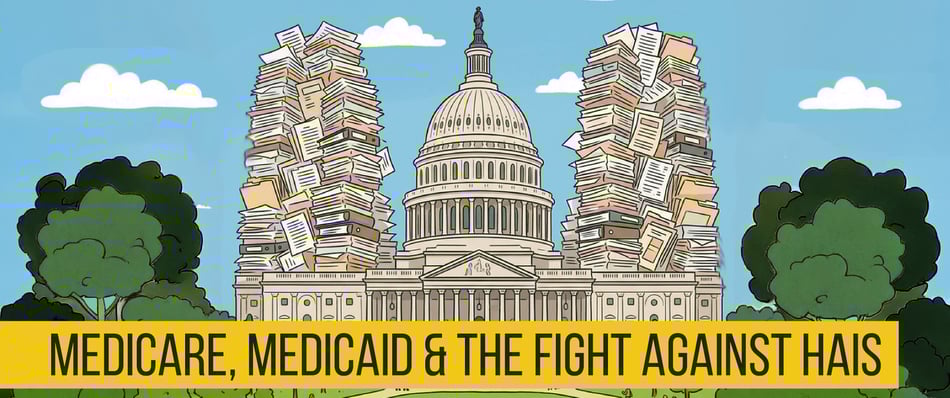
In 1965, a sweeping update to the Social Security Act quietly introduced two programs that would transform American healthcare: Medicare and Medicaid. Medicaid, at its inception, was little more than a single line in Title XIX. But over the decades, both programs have evolved into central pillars of the U.S. healthcare system, covering more than 130 million people combined and continually adapting to improve efficiency, reduce waste, and drive better patient outcomes. In today's post, to honor Medicaid Awareness Month, we'll explore this program in the context of the federal healthcare system and touch on its impact on HAI rates.
|
Surprising Statistics 15% of Americans confuse Medicare and Medicaid 30% of Medicaid enrollees do know know they are on Medicaid, believing they have private insurance (due in part to the various names Medicaid goes by, depending on the state). This can impact their support for the program at the ballot box. 25% of Americans incorrectly believe Medicare covers long-term nursing care (because Medicare covers elderly Americans): Long-term care is primarily a Medicaid benefit |
Let's start by unpacking the differences between Medicaid and Medicare. One of the most important distinctions between the two programs lies in how they are structured and funded.
Two Different Programs
-
Medicare is a federally administered health insurance program, primarily serving individuals aged 65 and older, as well as certain younger people with disabilities. It is standardized across the country and divided into four parts: Part A covers hospital services, Part B covers outpatient medical care, and Parts C and D are administered by private insurers to provide expanded and prescription drug coverage.
-
Medicaid, by contrast, is a joint federal and state program designed to serve low-income individuals and families. While the federal government establishes baseline requirements, states have flexibility in how they expand eligibility and benefits. Core Medicaid coverage includes inpatient and outpatient care such as hospitalizations, lab work, imaging, and physician visits. Depending on the state, additional services may include prescription drugs, case management, and therapies like physical and occupational therapy.
The cost structures reflect these differences. Medicare beneficiaries typically face premiums, deductibles, copayments, and coinsurance, depending on their plan. Medicaid costs, however, are largely determined by income and eligibility criteria, often resulting in minimal out-of-pocket expenses for enrollees, though specifics vary by state.
Focus on Expansion
Over time, Medicaid has undergone a series of significant transformations, each building on the last to expand access while improving efficiency.
-
A key early milestone came in 1983 with the introduction of the inpatient prospective payment system (IPPS). This reform shifted reimbursement from paying for individual services to paying based on diagnosis, reducing overall medical spending by at least 20 percent while also shortening hospital stays and limiting unnecessary hospitalizations.
-
In 1986, eligibility expanded to include pregnant women and infants, a change driven in part by high infant mortality rates in Southern states. This marked an important step in recognizing Medicaid’s role not just as a safety net, but as a tool for improving public health outcomes.
-
The program continued to evolve in 1996, when eligibility was uncoupled from federal cash assistance. This allowed individuals to qualify for Medicaid without being tied to traditional welfare programs, significantly broadening access.
-
Just one year later, in 1997, the creation of the Children's Health Insurance Program extended coverage even further, ensuring that children up to age 19 in working families could receive health insurance.
-
The passage of the Affordable Care Act in 2010 marked another major expansion. It created new pathways for individuals to purchase insurance through marketplaces and, beginning in 2014, allowed states to expand Medicaid eligibility to cover even more people.
Today, Medicaid covers roughly one in five Americans, including about 60 percent of nursing home residents, totaling around 71 million people. Medicare, by comparison, provides coverage to approximately 65 million individuals. Medicaid also plays a critical role for vulnerable populations, covering 8 in 10 children living in poverty and about 40 percent of all births in the United States, rising to roughly half of births in rural areas.
Focus on Efficiency
As these programs expanded, policymakers increasingly focused on not just access, but value. A central theme became clear: improving outcomes while reducing unnecessary costs. One of the most significant targets in this effort has been Healthcare-Associated Infections.
HAIs represent a unique challenge. They are common, costly, and in many cases, preventable. For programs like Medicare and Medicaid, which collectively fund a large portion of U.S. healthcare, preventable complications like infections are not just clinical issues but financial ones as well.
In 2008, Medicare and Medicaid took a decisive step by ending reimbursement for certain costs associated with preventable HAIs. This marked a fundamental shift in philosophy. Instead of paying for complications after they occurred, the system began incentivizing their prevention.
The Affordable Care Act reinforced this approach by introducing performance-based penalties for hospitals with poor outcomes. Infection rates became a key component of these evaluations, alongside metrics like readmissions. Hospitals that failed to meet benchmarks faced reduced reimbursements, creating a direct financial incentive to invest in infection prevention.
This evolution reflects a broader arc in the history of Medicare and Medicaid. What began as programs focused primarily on access have become sophisticated systems designed to reward quality and efficiency. In that context, reducing HAIs is not just a clinical priority but a financial and policy imperative.
For healthcare facilities, this alignment has real implications. Preventing infections is no longer solely about patient safety, although that remains the most important goal. It is also about sustainability in a system that increasingly ties reimbursement to outcomes. As Medicare and Medicaid continue to evolve, one thing is clear: The future of healthcare reimbursement will be defined not by how much care is delivered, but by how well it is delivered. And in that equation, preventing healthcare-associated infections sits squarely at the center.
![[infographic] Public Health Systems Download and share!](https://no-cache.hubspot.com/cta/default/216314/interactive-177841523491.png)