
If you spend any time at all in the world of infection control and prevention, you've run across...
What the U.S. Leaving the WHO Means for Global Health—and Our Own
In 1948, in the shadow of World War II, the United States became one of the first countries to join the newly formed World Health Organization (WHO). At the time, the world had learned a painful lesson: Global instability thrives where health systems collapse, economies falter, and international cooperation breaks down. The WHO, as part of the United Nations, was created to prevent a return to that chaos by promoting global health, coordination, and shared responsibility.
For decades, the United States played a central role in the mission of WHO, "to promote health, keep the world safe, and serve the vulnerable, ensuring that all people attain the highest possible level of health." As not only a founding member, the US was also historically the WHO’s largest funder and one of its most influential participants. That long-standing role came to an end when the current administration withdrew the U.S. from the organization, a decision formalized just this month. Reasons given for the withdrawal were that the WHO had mishandled the COVID-19 pandemic and that the United States has not been receiving sufficient value for the amount it contributed financially.
In statements issued by the Department of Health and Human Services (HHS), the federal government confirmed that U.S. financial support for the World Health Organization ended on January 20, 2026. HHS also reported that American government employees and contractors working with the WHO have been withdrawn, and that the United States is no longer participating in the organization’s formal committees, governing bodies, or technical advisory groups. The department noted, however, that talks were continuing about the possibility of maintaining narrowly defined cooperation in select areas, including influenza vaccine–related activities.
One of the most immediate questions raised by this decision is whether U.S. researchers and scientists will still be able to actively engage with the WHO. The answer is yes... somewhat. American scientists can still technically participate in WHO-related work, collaborate informally, and access some shared resources. But this participation will be fundamentally different. Without formal membership, U.S. researchers will have to seek out these opportunities (individually, by state health department, or by independent agency/organization). They lose the coordination mechanisms that previously allowed global health efforts to move quickly and efficiently. They also lose the institutional clout that comes from having WHO backing when translating research into policy or action, such as influencing vaccine development, pharmaceutical standards, or international health regulations.
This loss of coordination matters. WHO membership gives scientists not just access to information, but a seat at the table where decisions are made. Without that seat, U.S. scientists no longer have a direct role in decisions about vaccine strain selection, disease surveillance priorities, or global response strategies. Their expertise may still be shared, but it carries less weight without the authority that accompanies formal participation.
Data access is another critical concern. The WHO maintains and coordinates some of the world’s most important infectious disease monitoring systems, including databases tracking influenza and emerging pathogens. U.S. scientists will still have limited access to some of this information, but not to the full underlying datasets. That means less visibility into how data was collected, which sources were used, and how analyses were performed. These details are not academic—they directly affect the timeliness and accuracy of responses, including the annual development of influenza vaccines and early warnings for new infectious threats. Essentially, the US will no longer consistently have "a finger on the pulse" of global health.
Over time, reduced access to raw data and early-warning systems could slow the U.S. response to emerging diseases, weakening preparedness and increasing the risk of outbreaks reaching American communities before countermeasures are ready.
There are also less tangible, but equally serious, potential consequences for U.S. scientists working internationally. In many parts of the world, American researchers have already been viewed with suspicion, sometimes perceived as extensions of U.S. political or economic power. By formally withdrawing from the WHO, the United States further reinforces those concerns. The decision can signal disengagement from a shared global responsibility, making U.S. scientists appear not just potentially threatening, but actively uncooperative. This will make it harder to conduct vital healthcare work, build trust, and collaborate in countries where partnerships are essential for disease control and humanitarian response.
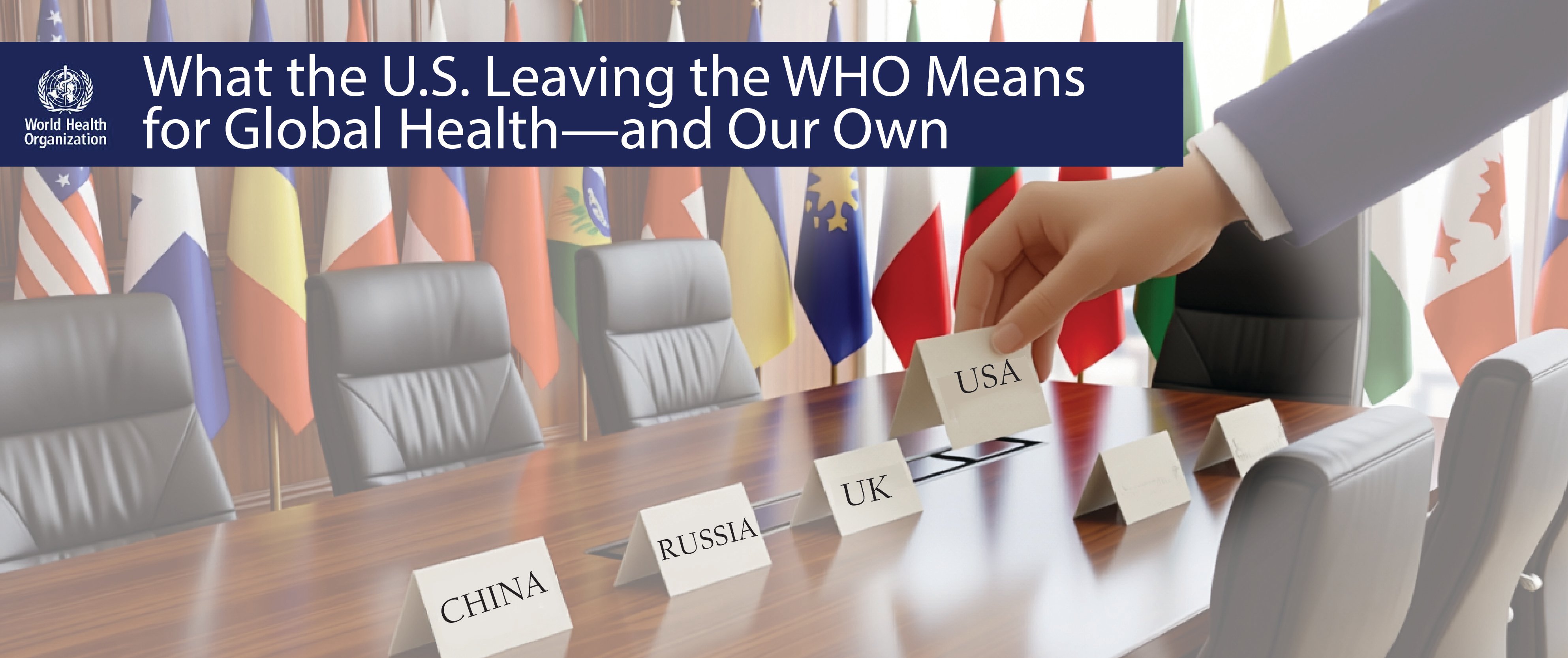
At the institutional level, the U.S. departure leaves a vacuum. The WHO does not stop functioning because one country leaves, but leadership gaps (vacant seats at the table) do not remain empty for long. Other nations will step in to fill the space, and with them come different priorities, values, and geopolitical interests. Those priorities will shape future WHO guidelines, funding decisions, and global health strategies. Without U.S. participation, American perspectives on transparency, scientific standards, and public-health governance will carry less influence. And nobody will be at the table to ensure that US interests are present, understood, and considered.
The financial impact is equally significant. As the WHO’s largest historical funder, the U.S. withdrawal immediately reduces the organization’s budget, directly affecting its ability to deliver services that many low- and middle-income countries have historically relied upon. These services include disease surveillance, vaccination programs, maternal and child health initiatives, and emergency outbreak responses. When these systems weaken, global health suffers.
And global health does not exist in isolation. Poor health outcomes undermine economic stability, disrupt supply chains, and increase the likelihood of humanitarian crises. Economic instability, in turn, fuels mass migration, political unrest, and conflict. These cascading effects were precisely what the United Nations and the World Health Organization were designed to prevent in the aftermath of World War II.
Leaving the WHO is not a "simple withdrawal" from an international organization. It is a massive departure. This US is stepping away from a global, post-war consensus that recognized health as a foundation of peace, stability, and shared security. The long-term costs of that decision, measured in delayed responses, weakened partnerships, and global instability, are likely to be felt not just abroad, but at home.
![[infographic] Global Health Channels Download and share!](https://no-cache.hubspot.com/cta/default/216314/interactive-179319733095.png)