![EOScu Logo - Dark - Outlined [07182023]-01](https://blog.eoscu.com/hubfs/Eoscu_June2024/Images/EOScu%20Logo%20-%20Dark%20-%20Outlined%20%5B07182023%5D-01.svg)



The scientific method demands that researchers follow logical steps in their process to ensure that...
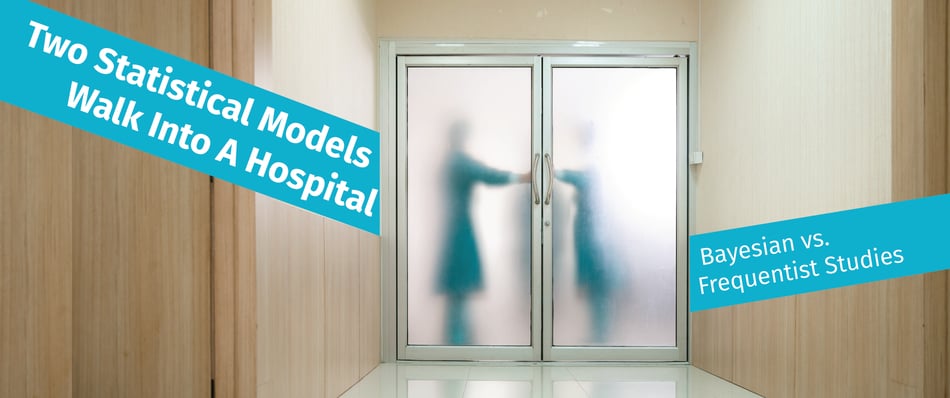
Two Statistical Models Walk Into A Hospital: Bayesian vs. Frequentist Studies
Healthcare leaders are under constant pressure to make decisions based on evidence, especially when it comes to preventing healthcare-associated infections (HAIs). But not all evidence is created equal. The way a study is designed and how its data is analyzed can dramatically influence how much confidence we should place in its results. Specifically, when infection prevention research uses Bayesian statistics, the result is a fundamentally different (and often more practical) way of interpreting data compared to traditional approaches. Understanding why this matters can help clinicians and administrators better evaluate new technologies.
The Problem with “Did It Work or Not?”
Most clinical studies you encounter rely on what’s called frequentist statistics. This is the traditional framework behind p-values and statements like:
- “The results were statistically significant (p < 0.05).”
- “We failed to reject the null hypothesis.”
While widely used, this approach has a limitation: It doesn't really directly prove that the intervention caused the change, but rather, if any measured change could be explained through chance alone. "What are the chances we would get this result if the intervention did not have any effect?"
Let's consider infection prevention. Healthcare associated infections (HAIs0 are influenced by dozens of variables:
- Patient populations such as age, co-morbid conditions, and other factors
- Staff compliance with hand hygiene and antimicrobial stewardship, among other things
- Environmental cleanliness
- Use of indwelling devices
- Random chance
A study might show no “statistically significant” reduction in infections, even if the intervention actually helped, especially if the many other factors that influence HAIs were present. Or it might show significance when, in fact, the change was due to something other than the intervention but was not taken into consideration. For example, if a hospital was measuring the efficacy of a new hand hygiene program but did not take into consideration the Hawthorne effect.
Taking Multiple Variables into Consideration: Bayesian Statistics
Bayesian statistics takes a different approach. Instead of asking: “Was the change due to something rather than chance?” It asks: “Given everything we know, how likely is it that this intervention works,and by how much?” The results are a lot more practical and helpful.
How does this statistics model accomplish this feat? In short, the statistical model learns.
- Incorporates prior knowledge (earlier studies, biological plausibility, real-world experience) into the statistical model, allowing for real-world impact
- Update conclusions as new data becomes available
- Provide probabilities that are directly interpretable
Instead of a yes/no answer, you get something like:
- “There is a 92% probability that this intervention reduces infections.”
- “There is an 85% probability the reduction is at least 20%.”
That’s far more aligned with how clinicians actually think and make decisions.
|
|
Why This Matters in Infection Prevention
Infection prevention is inherently complex and probabilistic. It's about managing risk across dynamic systems. Bayesian methods are particularly well-suited because they:
1. Reflect Real-World Complexity | They allow for variation across units, patient types, and time periods, something especially important when evaluating environmental interventions like biocidal surfaces.
2. Incorporate Existing Evidence | If previous laboratory and clinical studies suggest a mechanism (e.g., copper’s biocidal activity), Bayesian models can formally account for that knowledge instead of starting from zero.
3. Provide Actionable Results | Results provide hospital leaders with data they need to know: How likely something is to work, how large the benefit might be, and whether it’s worth the investment.
A Different Way of Thinking
Some healthcare decisions are more clear cut than others: Does the medication work? Does this therapy improve patient outcomes? However, when complex systems and relationships exist, they must be examined in a way that can accommodate all those factors. Bayesian statistics represents a shift toward painting a more complete picture of the situation, leading to more informed decision-making.
For infection prevention professionals tasked with protecting patients in complex environments, understanding the different statistical models they will encounter in peer-reviewed research is important. As new studies emerge evaluating interventions like biocidal surfaces, it’s worth paying close attention not just to what the results say, but how those results were generated.