
Surface disinfection has become the new normal. Today's post takes the concept of a high school...
Bayesian Statistics: Probably vs. Plausability
Erica Mitchell
3
min. read
Bayesian Statistics: Probably vs. Plausability
5:22
In the 1740s, a British minister named Thomas Bayes sat with a puzzle that had nagged at philosophers for centuries: How do we update what we believe when new evidence arrives? His answer, published posthumously in 1763, gave the world a simple but radical idea. Belief isn't binary. It's a probability, and every new piece of information should impact it. Two and a half centuries later, his theorem sits at the center of some of the most important decisions in modern medicine.
The Traffic Light Analogy
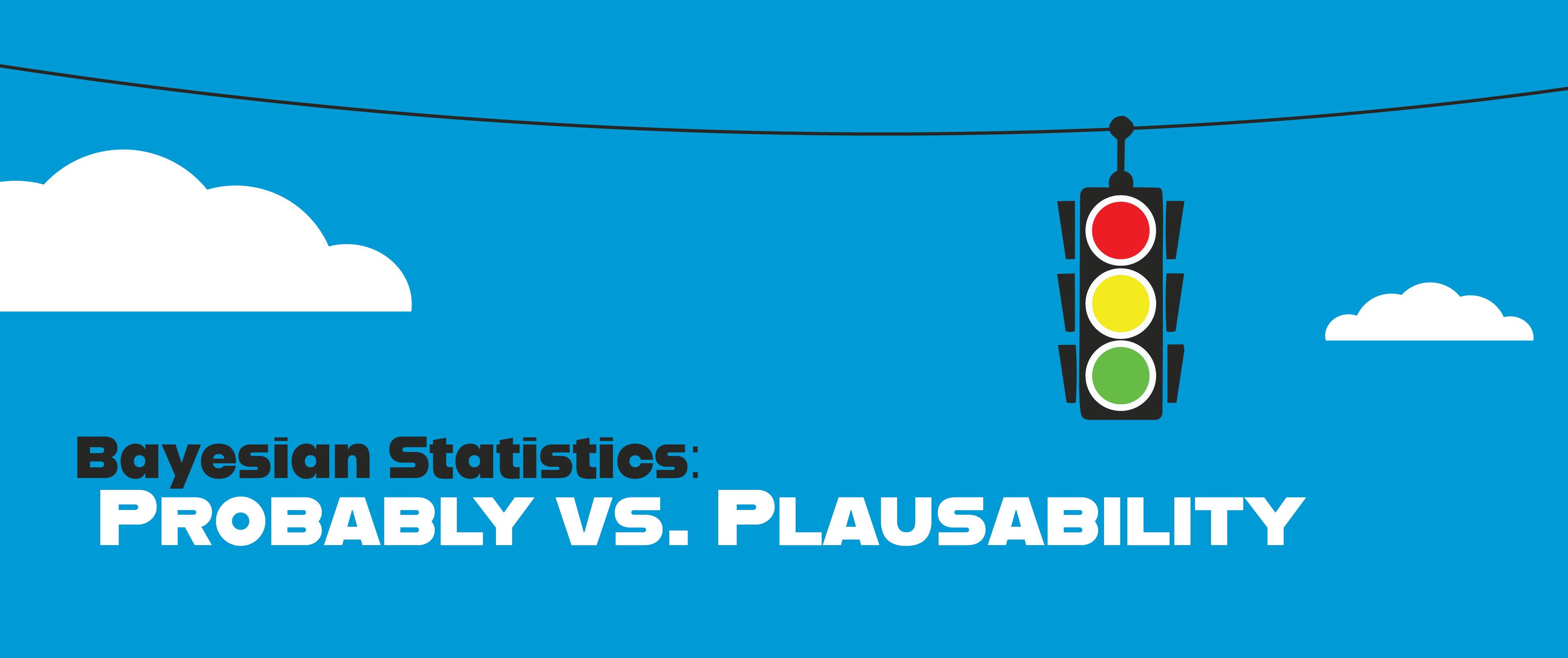
Consider this. When a stop sign at a busy intersection is replaced with a traffic light, the goal is simple: fewer accidents. Figuring out whether that change actually worked and why is where statistics comes in. Two common approaches, frequentist and Bayesian analysis, look at the same question from slightly different angles.
Imagine you collect accident data for a year before the traffic light and a year after. A frequentist analysis treats those time periods as a kind of controlled comparison. It asks: If the traffic light had no real effect, how likely would it be to see a difference in accident counts this large just by chance? The result is usually expressed as a "p-value" or a "confidence interval". If the difference is unlikely enough, that is, it was not predicted under normal circumstances without the intervention, it's considered statistically significant, the conclusion is that the traffic light probably made a difference.
In this framework, the focus stays tightly on the observed data without considering additional impact from traffic lights, drivers, weather, or other conditions that could have impacted accident rates (confounders). It relies on the idea of repeated sampling, as if this same intersection could be observed over and over again under similar conditions.
A Bayesian analysis approaches the same situation by combining what is already known with what is observed during the study. Before looking at the data, you might have some expectation that traffic lights tend to reduce accidents based on studies of other intersections. That expectation is called a prior. Then you collect your before-and-after data and update that prior belief.
The result is a probability statement that is more direct. For example, you might conclude there is a high probability that the traffic light reduced accidents by a certain percentage. Instead of asking how surprising the data would be under a no-effect assumption (chance alone), the Bayesian method asks what is now most plausible given both past knowledge and current evidence.
Both approaches use the same raw information about accidents at the intersection, but they answer slightly different questions. The frequentist method evaluates how likely any deviation from the expected observations is due to chance alone. The Bayesian method updates expectations about the effect of the traffic light by integrating knowledge about other factors that influcence car accidents. For example, it could filter out the reductions that were probably due to weather, construction, and other factors in order to reveal the most plausible number of avoided accidents due directly to the new traffic light.
How about in the context of infection control and prevention?
Now that we've considered the traffic light analogy, let's look at infection control and prevention. The goal here is not to reduce accidents, but rather infections. Frequentist studies are common in IP, since they are less time-consuming and the statistics are more simple. These studies say "We used this intervention and the infection rates went down by more than what would be expected. Our intervention probably made a difference." You'll see this all over the literature, with key terms such as "p-value," "confidence interval," and "statistically significant" serving as excellent markers.
On the other hand, Bayesian statistical modelling is complex, time-intensive, and requires a degree of expertise typically found in a biometric specialist, not a physician, nurse, or infection preventionist. As a result, Bayesian modeling is found in far fewer studies, and most likely only in studies with large teams of investigators covering a range of skills, including biometrics. This type of statistical modeling requires extensive research to compile the priors, and then the ability to input that data into the modeling software and set up the correct parameters to generate quality results. Markers for Bayesian studies will include phrases such as "prior/posterior distribution," "hierarchical model," "credible interval" and "model checking."
In the end, both models are helpful and necessary steps towards determining what is really happening with an intervention. Frequentist studies reveal the probability that an intervention had an impact on infections, so that Bayesian studies can then reveal how many infections were plausibly reduced as a direct result of the intervention.
Now that you know the difference between these statistical models, keep a look for them as you continue to read your journals. Which do you see most often? Which results are more compelling? Share your thoughts in the comments below!